There is a moment in every Shaker kitchen renovation when the room is almost finished. The doors are hung. The worktop is down. The painter has left. And then you look at the handles - the ones you chose three months ago, ordered in a hurry, fitted without much thought - and something is wrong.
Not catastrophically wrong. Just off. A slight flatness where there should be warmth. A modernity that fights the simplicity of the doors. A size that looked fine on screen but now sits awkwardly against the frame.
You cannot explain it precisely. But you can see it. And once you can see it, you cannot stop seeing it.
This is not an obscure problem. It is one of the most common regrets in kitchen renovation, and it happens for a specific reason: cabinet handles are chosen last, when the budget is stretched and the patience is thin, and they are treated as a finishing detail when they are actually a structural one.
The handle is the only part of your kitchen you touch every single day. It sets the material register for the whole room. And in a Shaker kitchen - where the design depends entirely on restraint and proportion - the handle either resolves everything or undoes it.
This guide will help you choose correctly the first time.
The Problem: Why Shaker Kitchens Are Harder to Hardware Than They Look
The Shaker style was developed in the eighteenth century by a religious community who believed that beauty and function were the same thing. The aesthetic that carries their name - inset panel doors, simple lines, no ornamentation for its own sake - is so enduring precisely because it has no excess to date.
But that restraint creates a problem. When a design contains nothing superfluous, every element carries more weight. A Shaker door with the wrong handle is like a perfectly tailored suit with the wrong buttons. The eye goes straight to it.
Most people know the obvious mistakes: cheap zinc-alloy handles that turn green within a year, oversized bar pulls that overwhelm a small door, or chrome finishes that look lifted from a 2009 bathroom refit. What fewer people know is how to identify what is actually right - and why.
The Solution: Three Decisions, in the Right Order
Decision One: Material
The single most important specification for a Shaker kitchen handle is the material. Not the finish. Not the size. The material.
Solid brass is not the only choice - but it is the correct one if you want a handle that performs over decades rather than years.
Here is the distinction that matters: most handles sold for kitchen use are brass-plated zinc or brass-plated aluminium. The plating looks identical in a product photograph. On installation, it looks identical. The difference appears after six months of daily use - worn patches at the grip point, green corrosion around the fixings, a handle that has aged badly in a kitchen designed to age well.
Solid brass has no plating to wear through. The material is the same from surface to core. It develops a natural patina that deepens over time rather than deteriorating. In a Shaker kitchen - where the proposition is that everything was chosen to last - a handle that visibly degrades is a logical contradiction.
Clemo + Finch makes every handle, knob, and pull from solid brass. It is not a marketing distinction. It is a production decision that costs more and produces a different object.
Decision Two: Finish
Once you have established solid brass as your material, there are six finish directions to consider. Each one creates a different relationship with the kitchen.
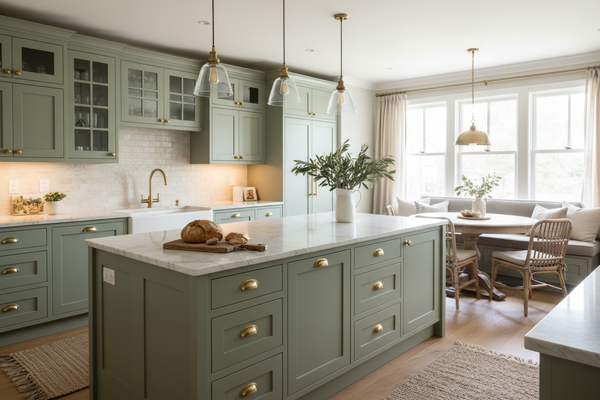
Satin Brass is warm but not bright. It has the depth of brass without the reflectivity of a polished surface. In a navy or deep green Shaker kitchen - the most common palette - it is the natural complement. The warmth of the metal against the cool depth of the paint is a contrast that has been working in British kitchens for two centuries.
Midnight Bronze is richer and more formal. It reads as confident and deliberate. Use it in a kitchen where you want the handles to be noticed - against pale grey doors, or in a room with stone floors and warm plaster walls. In an unlacquered version, it will develop a living patina over time: darker at the grip, brighter at the edges. Some people find this beautiful. Others find it difficult to manage. We will come to that.
Antique Bronze arrives already patinated - a warm, slightly darkened finish that reads as inherited. This is the correct choice if you want the handles to feel as if they belong to the building rather than the renovation. In a period kitchen with original features, Aged Brass resolves the question of whether your new hardware looks new.
Ceramic Black is bold and contemporary without abandoning warmth. Against white or pale grey Shaker doors, it creates a graphic contrast. Against dark cabinetry, it reads as considered and deliberate. It is the finish that works hardest across the widest range of kitchens.
Satin Nickel is silver-toned and therefore pairs most naturally with stainless appliances, marble worktops, or kitchens where the palette runs cooler. It is a calm, precise finish - less warm than brass but more considered than chrome.
Polished Chrome is bright and highly reflective. In a Shaker kitchen, it requires care. A period-style Shaker room with chrome handles can look inconsistent - the finish belongs to a different century. In a contemporary Shaker kitchen, particularly one with integrated appliances and minimal decoration, it can work well.
The question to ask is: what is the warmest element in the room? Your handles should either match or complement it. A warm kitchen tolerates cool handles. A cool kitchen rarely tolerates warm ones.
Decision Three: Size and Profile
The proportioning rule for Shaker cabinet handles is simple but frequently ignored: the handle should be long enough to feel deliberate, and short enough not to overwhelm the door.
For a standard 600mm wide door, a bar pull between 160mm and 200mm in length (measurement centre-to-centre between fixings) is the working range. Below 160mm, a bar pull looks tentative on a full-sized door. Above 220mm, it begins to compete with the door panel itself.
For drawer fronts, you can go longer. A 300mm bar pull on a pan drawer below a hob reads as intentional. The drawer is wider; the pull can be wider.
Knobs follow different logic. The visual weight of a knob comes from its diameter and projection, not its length. A 35–40mm diameter knob on a standard Shaker door will sit correctly. Below 30mm, it disappears against the panel. Above 45mm, it begins to look decorative in a way that conflicts with Shaker restraint.
Profile matters too. A handle with a rounded, considered cross-section sits naturally in the hand. A handle with sharp edges is tiring to use over years of daily contact. This is not merely comfort - it is a measure of whether the object was designed to be touched.
What a Different Choice Looks Like
There is a composite version of this story that we hear often.
A kitchen renovation. Shaker doors in a deep blue-green. Good worktops. Real thought has gone into every element - except the handles, which were chosen quickly from a large online retailer. Matt black, machine-made, 128mm bar pulls. Not wrong, exactly. Just not right.
The room looked almost finished. The handles were flat where they should have had depth. They were a colour rather than a material.
The kitchen was three months old before a decision was made to refit them. The new specification: Callington bar pulls in Satin Brass, 160mm centre-to-centre, solid brass. The installation took an afternoon.
The change is not dramatic in the way that a new tile or a different worktop is dramatic. It is quieter than that. The handles now have a relationship with the room. The warmth of the brass picks up the warmth of the wood. The weight of the material matches the weight of everything else that was chosen carefully.
That is what correct hardware does. It disappears into the room because it belongs there.
The Callington Collection
The Callington is Clemo + Finch's house collection. A rounded form with a fluted grip - tactile without being decorative. It was designed specifically for the kind of kitchen that will be used every day for the next thirty years, and that will still look right in twenty of them.
It is available in all six finishes and in bar pull lengths from 96mm to 320mm. If you are not certain which finish is right for your kitchen, the free sample service exists for that reason. Brass in your hand is a different decision from brass on a screen.