Door Handles for Period Properties: What Belongs, and Why
Most people who renovate period properties do it slowly. They research the architecture. They source period-appropriate materials. They understand, intuitively, that a Victorian townhouse and a 1970s new-build are different problems that require different solutions.
And then they fit the same lever handles that came in a pack of three from the same warehouse supplier that fits out student housing.
The door handle is a small object. It does not announce itself the way a fireplace or a flagstone floor does. But it is the first thing any visitor touches. It is touched dozens of times a day by everyone who lives in the house. And in a period property - where every element either belongs to the building or doesn't - the wrong handle is a small act of erasure.
This guide is about getting it right.
The Problem: Period Properties Have a Visual Contract
A period property carries an implicit contract with whoever lives in it. The building was designed with a specific aesthetic logic - proportions, materials, and details that were consistent with a particular time and a particular craft tradition. When you renovate correctly, you are honouring that logic. When you renovate carelessly, you break it.
Hardware is one of the clearest places where that contract is either kept or broken. An Edwardian door fitted with a brushed nickel lever handle in a contemporary profile is not a neutral choice. It is a visible inconsistency - one that signals, to anyone who knows what they are looking at, that the renovation was not fully thought through.
The complication is that most guidance on period hardware is either too vague ("choose something traditional") or too restrictive ("you must source original Victorian fittings"). Neither is useful. What follows is the practical version.
The Solution: Know Your Period, Know Its Logic
Georgian (1714–1830)
Georgian architecture is governed by symmetry, proportion, and classical restraint. The doors are typically panelled, the rooms are well-lit, and every element reflects the influence of Palladianism - the Italian classical tradition filtered through British rationalism.
Georgian door hardware was predominantly brass - specifically, polished or lacquered brass, shaped with minimal decoration. The most common form was the knob: round, slightly domed, fixed to a round or octagonal back plate. Bar pulls were used on cabinets; lever handles were not common on interior doors.
What belongs: Round or oval door knobs in Polished Brass or Aged Brass, mounted on simple back plates. Clean lines. No Gothic or Arts and Crafts ornamentation - both belong to later centuries.
What to avoid: Lever handles of any kind. Contemporary profiles. Nickel or chrome finishes - both are modern materials that sit awkwardly against Georgian plasterwork and timber.
A note on Listed Buildings: If your property is Grade I or Grade II listed, any changes to original hardware - including removing and replacing door furniture - may require listed building consent from your local planning authority. Check before you remove anything original.
Victorian (1837–1901)
Victorian architecture is more varied than Georgian - the period spans six decades and encompasses Gothic Revival, Italianate, Queen Anne, and the later domestic vernacular of speculative suburban housing. The common thread is an enthusiasm for decoration and craftsmanship.
Victorian door hardware was typically brass - knobs, lever handles, and escutcheon plates - with more surface decoration than the Georgian period permitted. Fluted columns on a lever handle. Decorative casting on a back plate. The craftsmanship was visible by design.
Solid brass was standard in well-appointed Victorian houses. In the later Victorian period, cast iron was used in working-class housing and in utility spaces like servants' stairs and back kitchens.
What belongs: Solid brass lever handles or knobs with a back plate that has some visual weight - not a bare-bones minimal fixing, but not excessive ornamentation either. The Callington collection's fluted profile sits correctly in Victorian rooms because it acknowledges craft without pastiche. Aged Brass or Polished Brass are both appropriate; Satin Brass reads as slightly too modern for a formal Victorian interior but works well in Victorian spaces that have been updated.
What to avoid: Minimal, flat-bar contemporary lever handles. Anything that was designed after 1980 and knows it.
Edwardian (1901–1910)
The Edwardian period produced some of the most considered domestic architecture in Britain. The houses are lighter, airier, and more generous than their Victorian predecessors - larger windows, better proportions, a deliberate move away from the heavier decoration of the late Victorian period.
Edwardian hardware reflects this lightening. Lever handles became more common on interior doors. The profiles are cleaner than Victorian hardware, but the material remained solid brass, and the craftsmanship was still visible.
The typical Edwardian interior door fitting was a straight or slightly curved lever handle on an oval or plain rectangular back plate, in polished or satin brass. Simple, well-made, and proportioned for rooms that had been designed with light in mind.
What belongs: A lever handle in a clean profile - not aggressively contemporary, not heavily ornamented. The Callington range's solid brass construction and considered form is well-suited to Edwardian interiors. Satin Brass or Polished Brass; Aged Brass if the room has dark woodwork.
What to avoid: Anything too minimal - Edwardian hardware had presence, even at its cleanest. And anything too ornate - this is not a Victorian interior. The decoration had already been edited down.
Arts and Crafts (circa 1880–1920)
The Arts and Crafts movement was a philosophical as much as an aesthetic one - a reaction against industrial mass production, and a commitment to visible handcraft and honest materials. The movement produced some of the most thoughtful architecture in British history, including the work of Lutyens, Baillie Scott, and Voysey.
Arts and Crafts hardware was characterised by visible handwork: forged iron, hammered brass, and profiles that show the tool marks of their making. The aesthetic is the opposite of polish - deliberate irregularity, warmth, and material honesty.
What belongs: Solid brass with a hand-finished surface that shows its making. The Callington's fluted texture - which reads as handmade because it is - sits more naturally in an Arts and Crafts context than a machined, mirror-polished surface. Aged Brass or Blackened Brass; the latter has a warmth and depth that connects to the forged iron tradition of the period.
What to avoid: Polished chrome or bright nickel - both materials belong to the twentieth century and the industrial tradition that Arts and Crafts explicitly rejected.
One House, Two Different Renovations
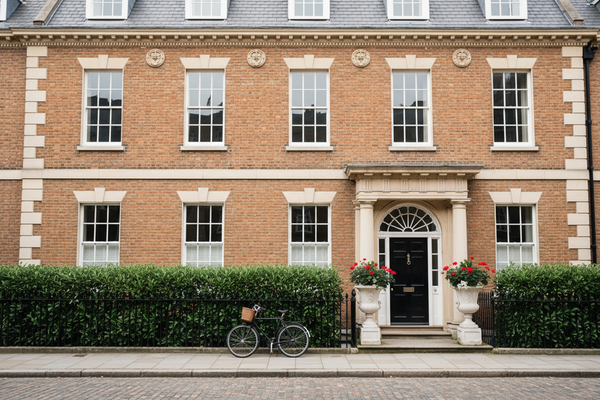
Consider an Edwardian semi-detached house in South London. Original doors, original cornices, original cast iron fireplaces. The kind of house that was built with care and has been lived in, imperfectly, for a hundred and twenty years.
It is renovated twice in the same year. The first renovation is fast. Lever handles from a DIY retailer - satin stainless steel, contemporary profile, 120mm length - fitted throughout. The original escutcheon plates are removed because the new handles came with their own plastic covers.
The house looks renovated. It does not look right.
The second renovation takes a different approach. Original handles on the principal rooms are repaired, not replaced. Where replacement is necessary - on the ground-floor WC, on the kitchen door - the specification is Callington lever handles in Aged Brass on simple oval back plates.
The difference is not the cost. The second approach cost less than the first. The difference is attention: understanding that the house was built in a particular tradition, and that every element added to it is either in conversation with that tradition or not.
The Callington fits because it is made of the same material as the original fittings, finished by hand, and sized for doors that were designed to the proportions of its period. It does not try to look original. It tries to belong.
A Note on Listed Buildings and Conservation Areas
If your period property is Grade I or II listed, or falls within a designated Conservation Area, the following applies:
- Removing original hardware may require listed building consent, even if the hardware itself is not of architectural significance.
- Replacing hardware with a non-original equivalent is a material alteration and may require consent.
- Replicating original hardware in the original material - solid brass, correct profile, appropriate size - is generally the most straightforward route to approval.
Always consult your local planning authority or a conservation architect before removing original fittings. The original handles, even if degraded, may be reparable. A damaged solid brass handle can be stripped, re-finished, and returned to use. A damaged zinc-alloy replica cannot.
The Callington Collection
The Callington was designed for exactly the kind of room that has some history to it. Its fluted grip acknowledges craft. Its solid brass construction means it will outlast the doors it is fitted to. It is available in six finishes, with the correct back plate options for period door architecture.
If you are unsure which finish is right for your property, the sample service is the answer. Brass in your hand, against your original woodwork and plasterwork, is a different decision from brass on a screen.
[Explore Callington Pull Bar →]
[Purchase a Sample →]
[Guild programme for trade professionals →]